It’s anyone’s guess how Putin’s desperation will shape his war next, but there’s a longer-term threat to eastern Europe as a whole – relentless demographic decline – and I wrote a piece last month on attempts by Russia to expand its population by issuing passports in the Ukrainian territories it had occupied. Those efforts are now in disarray – not least because some collaborators have been fleeing towards the Motherland, only to find that Russian border guards won’t now honour their supposed passports – but the basic point of the piece stands. Putin’s aggression, appalling though it is, reflects far deeper problems. You can read what I wrote here: https://www.lrb.co.uk/blog/2022/august/passportisation
My trip through the Baltic states a couple of months ago ended with a brief excursion into north-east Poland. Though the region’s got more history than you could shake a stick at, only one thing’s really memorable about the town I visited. It’s a very big thing though. According to NATO and Kremlin military strategists, World War Three’s quite likely to kick off there. It seemed sensible to investigate, and I’ve just reported my findings to the world, via wireless. 17.30 onwards, if you wanna know what I learned . . .
Almost ten years ago, Boris Johnson’s sister told an interviewer that the prime minister, aged about five, used to say his ambition was to become ‘world-king’. It was a self-serving piece of family folklore, one she still loves to repeat, and it obscures more than it reveals. Power certainly appeals to Johnson, but he’s very aware of its fragility. Reflecting on the downfall of another proven liar, the Tory MP Jonathan Aitken, he once wrote: ‘Politics is a constant repetition, in cycles of varying length, of one of the oldest myths in human culture, of how we make kings for our societies, and how after a while we kill them to achieve a kind of rebirth. . . Some are innocent . . . some are less innocent. . . It doesn’t really matter. They must die.’
As that suggests, the prime minister’s understanding of responsibility is self-indulgent, melodramatic and nihilistic: he sees accountability as insignificant and assumes eventual failure. Until then though, he’s in thrall to the idea that he can do whatever he wants.
Nothing illustrates the fascination with impunity better than his perspective on Donald Trump, which changed dramatically over the course of 2016. Watching the property developer sweep rivals aside and reshape political realities, Johnson’s scepticism turned to admiration. Trump’s claim that he could have shot a pedestrian on Fifth Avenue without losing support out-Borised Boris himself. The rhetorical force impressed Johnson immensely, while its thuggishness didn’t much matter to him at all.
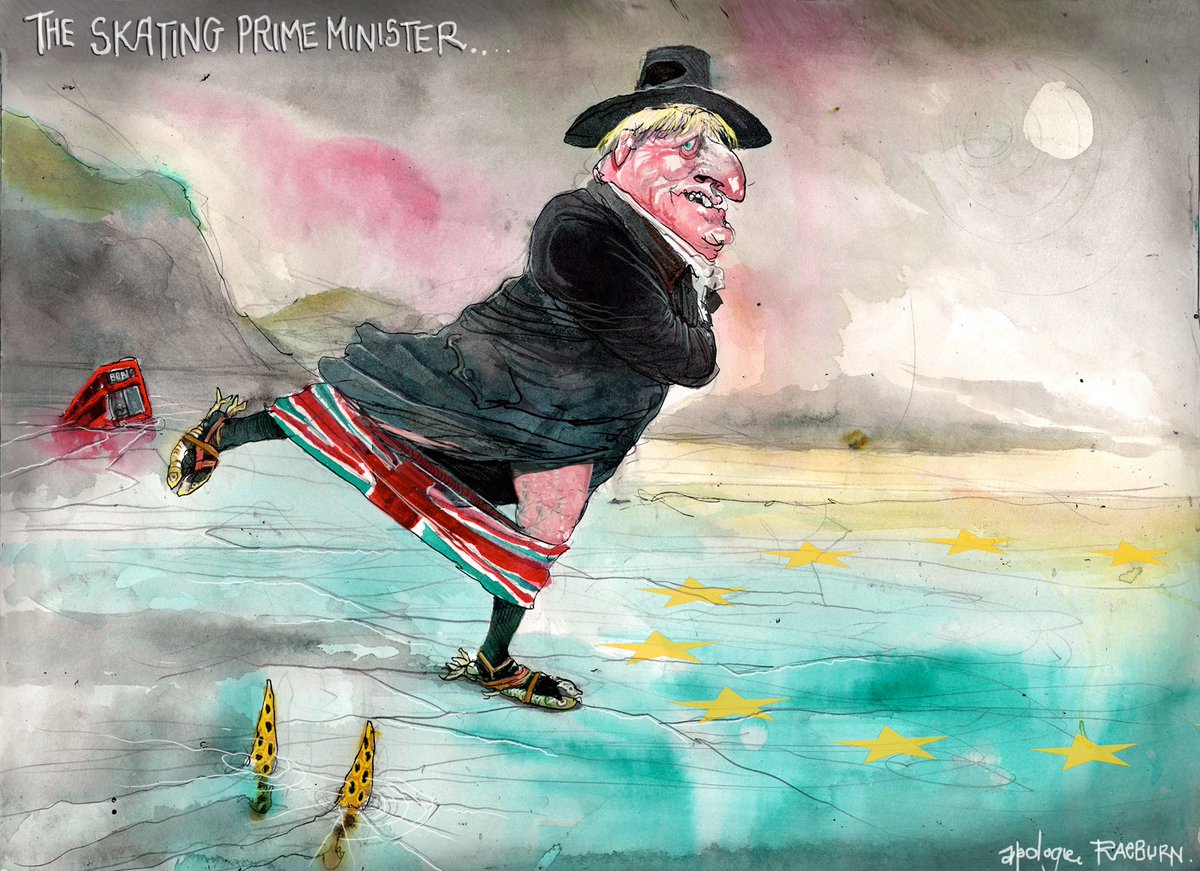
It looks at last as though Nemesis might be on the way, and, quite optimistically, I’ve just written a piece anticipating the PM’s political demise for the London Review of Books: https://www.lrb.co.uk/blog/2022/january/will-he-be-pushed-off-the-ice. Even the best case scenario is bad, however. As in the United States, the political landscape bulldozed into existence by Trump-style Johnsonianism could allow for even worse to emerge. . .
The Home Secretary has been duplicitous for years about her family background. As befits the Tory daughter of Ugandan Asian shopkeepers made good, Priti Patel has spun a Thatcheresque origin story to advance her career, and the tale of African rags-to-British riches isn’t just opportunistic. It started with a parliamentary speech about parents who arrived ‘with literally nothing’, and in its retelling by media outlets like the Daily Mail, it’s become dishonest. That doesn’t make her emergence as a hardliner very unusual. Other supposedly self-made politicians who’ve been keen to kick away the ladders that enabled their success include Nigel Farage (descended from a German economic migrant: https://is.gd/r2Rs6S) and Donald Trump (his grandfather, a draft-dodger from Kallstadt, made his first fortune by running brothels for Klondike-bound gold-diggers: https://is.gd/HdvYXn). Patel’s fakeness rankles enough for me to have written about it for the LRB though: https://www.lrb.co.uk/blog/2022/january/with-literally-nothing. There’s more to say, and I’ll be writing a sequel soon . . .
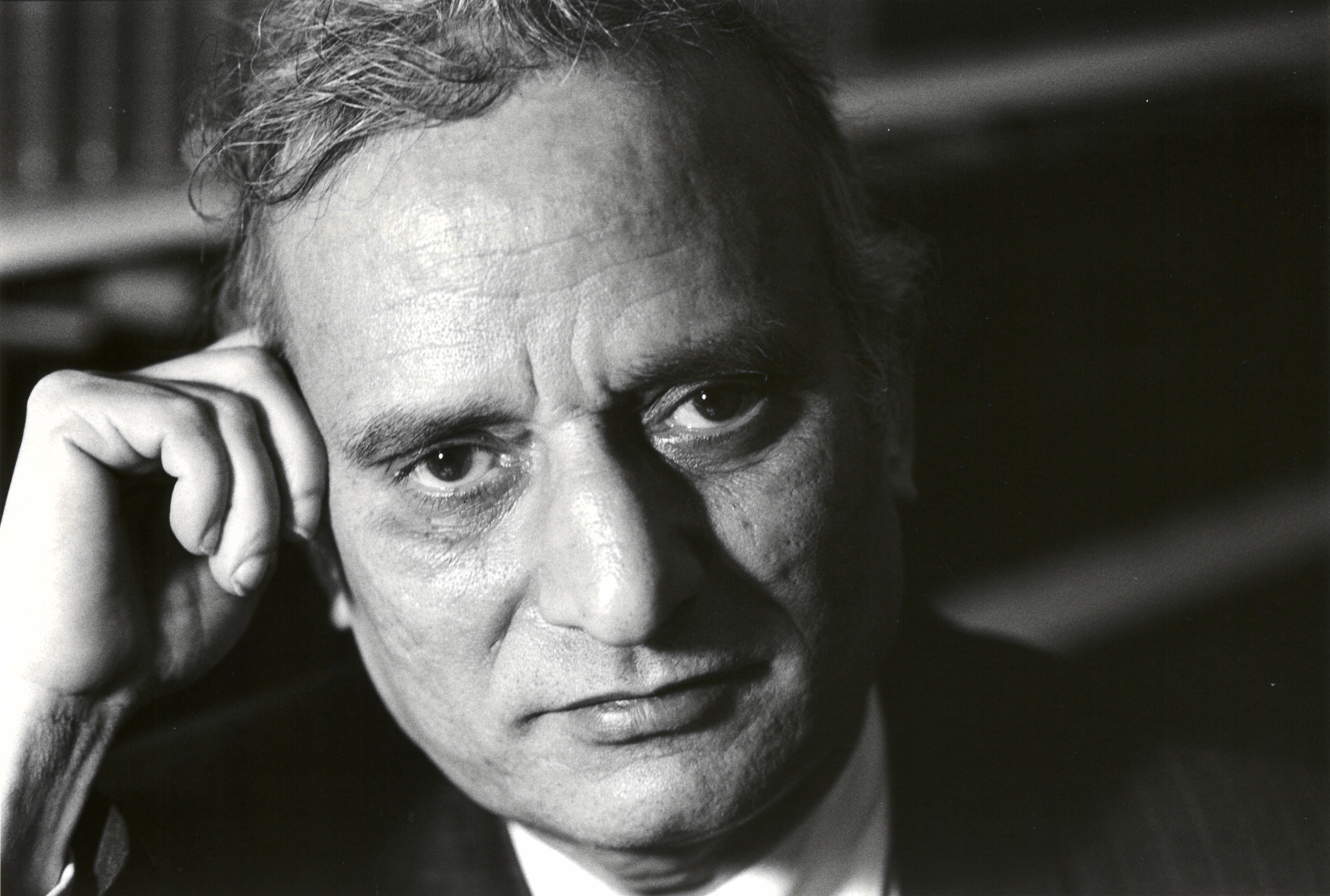
Sibghatullah Kadri QC (1937-2021): Anti-racism pioneer, co-founder of the Society of Black Lawyers, and the UK’s first Muslim QC
My dad just died. His career as a barrister was defined by his lifelong opposition to racism, and though that provoked fierce criticism from legal reactionaries during the 1970s and 1980s, it’s fair to say he won the argument in the end. Tomorrow, 4 November 2021, the Inner Temple will fly its flag at half mast in his memory.
When his health seriously declined a year ago, we started talking regularly about the past. They’re years I’m all too familiar with – even as a kid, me, my mum and my sister would go with him to rallies against skinheads and neo-Nazis in places like Whitechapel and Lewisham and Southall – but his career forms part of a history that’s often forgotten. So, though it suddenly feels very much like a lifetime away, I figured I’d post something that I contributed to a forthcoming exhibition at the Inner Temple. It wasn’t drafted as obituary, but it’s become one. . . .
Sibghatullah Kadri, known to colleagues and friends as Sibghat or Shiblee, was born in Uttar Pradesh ten years before the partition of India. In late 1949, he moved with his entire family to Karachi in West Pakistan. Sharing a single room with his parents and seven siblings, he taught younger children to fund his own education, and enrolled for a chemistry degree in 1954.
At Karachi University, his scientific studies were soon complemented by broader, political concerns. Elected head of the students’ union, he spoke up for constitutional democracy and civil rights during a volatile period of Pakistani history, and was among those detained after General Ayub Khan’s coup of 7 October 1958. Though he was released six months later (having learned to draft his own habeas corpus petition), the price was expulsion from university and exile to a city a hundred miles outside Karachi.
The move to London in November 1960 was an unhappy accident – occasioned by the need to visit a dying sister who was already in England – but it proved permanent. And the injustice he’d experienced under a military dictatorship now gave him a new focus: he would study law. In August 1961, the Inner Temple admitted Kadri despite his lack of a degree, on the basis that he shouldn’t suffer twice for his arbitrary imprisonment, and he began Part I of the Bar Exams. That was a part-time course in the 1960s, and it took him two years to sit the five papers, working as a postman, a clerk for a mail order firm specialising in ‘ladies slimming garments’, and a waiter at a Kilburn curry house. The third job was almost literally his last; it ended when a white customer drunkenly refused to pay his bill and stabbed Kadri in the face. The attack sent him to hospital for three weeks.
Not everything was tough; 1963 was also the year that he married Carita Idman. The couple soon had two children, and to support the family as it grew, Kadri found work again. After contributing to the BBC as an ‘immigrant spokesman’ for the Campaign Against Racial Discrimination (an organisation established in 1964, soon after a visit to England by Martin Luther King), Kadri was offered a staff job at the Urdu Service.
In the autumn of 1968, Kadri was finally ready to study for the Bar Finals – and his year at the Council of Legal Education would be transformative. The CLE of the 1960s was structurally skewed to benefit British university graduates, and Kadri was soon articulating grievances that were widespread among Commonwealth students. Speeches propelled him to prominence, and a Bar Students’ Reform Committee, formed in September 1968, then staged a sit-in that made the front page and letters section of the Times. Kadri was promptly sacked by the BBC Urdu Service; when he turned up to read the news, his displeased boss said his services wouldn’t be required because ‘you are the news’.
Most of the protesters’ demands weren’t met, but the BBC eventually took him back and Kadri’s leadership was vindicated by the sit-in’s one durable success: the creation of representative student bodies at the Inns of Court. He was elected to be the first president of the Inner Temple Student Association, defeating John Laws (later, a Lord Justice of Appeal).
After leading a second CLE sit-in the following November – supported by fellow radicals who included the future Baroness Helena Kennedy and Jack Dromey MP – Kadri was called to the Bar. Early in 1970, he collaborated with two other barristers, Rudy Narayan and Byron Hove, to establish the very first organisation concerned with racism in the legal profession. The Society of Afro-Asian and Caribbean Lawyers (renamed the Society of Black Lawyers in 1981) aimed to eliminate racial discrimination among lawyers and to facilitate equal justice for all.
Kadri became headline news in April 1970. As legal adviser to the Pakistan Workers Association, he responded to the recent stabbing of a Bengali immigrant in London’s East End by reminding fearful Asians at a rally that the law allowed people to defend themselves. Likely victims of racist violence weren’t looking for trouble, Kadri told a Daily Telegraph reporter – ‘but they will be ready to deal with it.’ The forthrightness was too much for the BBC, which sacked him for a second time – on the grounds that it had to ‘tread with the most extreme care’.
It wasn’t just the BBC that seemed to be more troubled by opposition to racism than by racism itself. Kadri obtained a pupillage under (Lord) Tony Gifford at Cloisters, but though he enjoyed several notable early successes, his outspokenness meant no chambers would offer him tenancy. Two years later, confident that this wasn’t for lack of ability, Kadri found a typically radical solution. Aged 35 and fresh out of pupillage, he set up the UK’s first multi-racial chambers at 11 King’s Bench Walk.
That was in March 1973. Over the next two decades, Kadri developed a practice that was all but defined by his commitment to equal rights. Along with immigration and judicial review challenges, he took on criminal cases that became almost iconic: the defence of alleged rioters in Bristol and Brixton, for example, and members of the so-called ‘Bradford Twelve’ and ‘Newham Seven’, who were charged with defending their communities against violent racism. Working through bodies including the Society of Black Lawyers and the Standing Conference of Pakistani Organisations (SCOPO), Kadri combined lawyerly skills with a campaigner’s acumen. At a time when racist murders were multiplying across England, he mobilised beleaguered non-white communities in districts like Southall and Whitechapel; as a barrister, he regularly spoke out against racial bias among legal practitioners. As he recently described in a video presentation to the Inner Temple, Lord Denning was among those who admitted their mistakes; many did not.
In October 1981, Kadri addressed an international conference about race and the legal profession at Sussex University. His assessment of the situation in this country was bleak, but also impressive enough for Mr Justice Browne-Wilkinson (as he then was) to visit Kadri a day later at 11 Kings Bench Walk. Their constructive conversation led to the creation of a working committee on race relations chaired by Browne-Wilkinson. It evolved into a Race Relations Committee, and new anti-discrimination initiatives that are now institutionalised across the Bar.
In March 1989 Kadri took silk, and eight years later he was appointed a Bencher of the Inner Temple. Those are high honours, but a greater achievement is surely his lifelong pursuit of racial equality. In ways that were never easy, he pioneered essential reforms within a profession that is institutionally resistant to change, and sometimes hostile to it. Discrimination hasn’t vanished – as Kadri recently reminded younger barristers in his Inner Temple presentation, ‘the struggle continues’ – but the trail he blazed has cleared obstacles for countless others who followed. In itself, that illustrates the value of diversity. His entire life also stands as a timely reminder that justice loses its meaning without lawyers prepared to fight for it.
Last week’s Supreme Court ruling that Shamima Begum has no right to return to the UK isn’t the last we’ll hear of her. It certainly doesn’t establish that the Home Office can abandon citizens suspected suspected of bad things, just because they’re foreign enough to have vague chances of getting citizenship elsewhere. It’ll make it far harder for the 21-year-old to mount a substantive challenge, however. Sajid Javid’s original decision in February 2019 didn’t happen in a vacuum, and just in case anyone’s interested in remembering how we got here, I thought I’d repost a piece on citizenship-stripping that I wrote for the London Review of Books back in 2015: https://tinyurl.com/yak26563. It’s behind the LRB paywall, but if memory (and cut-and-paste skills) serve me right, the full text goes something like this . . .
“The removal of citizenship has been used as a penalty for disloyalty only rarely in Britain. A handful of spies with dual nationality were denaturalised during the Cold War, but the last case in the 20th century was in 1973. Change came slowly even after 9/11: only five people were stripped of British citizenship by Labour home secretaries, and the emblematic bogeyman of the era, the hook-handed Abu Hamza, repeatedly dodged moves to annul the Britishness he had gained through marriage. He didn’t manage to elude extradition to the United States, where he has now been jailed for life, but for what it’s worth, he remains notionally a British subject.
The obstacle to swifter executive action is the rule against statelessness. Originating after the Second World War, it reflected a belated concern about the removal of citizenship from Germany’s Jews in 1935. With the consequences of postwar decolonisation also at issue, the UK helped draft two treaties aimed at limiting the freedom countries had to abandon their residents. The rule counterbalanced a new power given to the home secretary in 2002 to withdraw citizenship from people who had ‘seriously prejudiced’ vital national interests. The criterion was broadened under the Immigration, Asylum and Nationality Act 2006, which made it possible to withdraw citizenship whenever it was ‘conducive to the public good’. Even in Abu Hamza’s case, the rule wasn’t challenged: the government argued instead that it wasn’t relevant, because the preacher remained Egyptian. The judges weren’t convinced: on the evidence they’d heard, Egypt seemed to have disowned him.
Soon after Theresa May became home secretary in May 2010, the Home Office lost its tussle with Abu Hamza, but she was determined to be more effective in her attempts to remove citizenship – and to do it more often. In her first six months in the job, she issued five revocation notices – as many as had been issued over the preceding 37 years – and the rate has accelerated steadily. By early 2013, she had moved against 32 more individuals, including at least five born in Britain. But last October, another inherited case got her in legal trouble. Hilal al-Jedda entered the UK in 1992, seeking asylum from Saddam Hussein’s Iraq. He was granted British citizenship in 2000. In 2004, he was detained by British forces in Iraq on suspicion of terrorist offences and held without charge for three years. Shortly before his release in 2007 the then Labour home secretary Jacqui Smith notified him that his citizenship was being removed. Home Office lawyers resisted his subsequent appeal by contending that he was still entitled to Iraqi nationality and could reapply for that if he wanted. The Supreme Court was unpersuaded. Al-Jedda argued that he shouldn’t be put in the position of having to ask Baghdad to take him back. The judges agreed: whatever Iraq’s response might be, it was Britain’s actions, not al-Jedda’s failure to act, that threatened him with statelessness.
None of this stopped May issuing an order to deprive al-Jedda of citizenship a second time. But the Supreme Court’s refusal to speculate on the future attitude of a foreign state spurred her to rewrite the rules. She told MPs in early 2014 that the court’s ‘disappointing’ decision had made it necessary for her to ask Parliament for further powers. The outcome was section 66 of the Immigration Act 2014, which gives the home secretary the power to reverse the granting of citizenship if a reasonable reading of another country’s laws suggests the individual could gain nationality there. The new powers could have been even more sweeping. May initially wanted the right to denaturalise British citizens without regard to statelessness. But section 66 is far-reaching enough. May had already shown herself ready to strip citizenship from dual nationals born in Britain. Now, so long as there is a chance of their gaining dual nationality, naturalised citizens will be at risk.
All the revocations that May has issued so far have survived judicial challenge, and an authoritative Supreme Court decision in March suggests that the legal wind is finally behind her back. An unusually large panel of seven judges, convened because of the importance of the case, upheld her withdrawal of citizenship from Minh Quang Pham, an alleged al-Qaida activist born in Vietnam. The judges ruled that Vietnam’s refusal to have him back imposed no obligation on the home secretary. The only fault they (implicitly) found was with officials in Hanoi, because Minh’s right to citizenship was clear under Vietnamese law, yet was being ignored.
If citizens can be forsaken on the off-chance that another country will take them on, who bears responsibility for the ones who end up with no nationality at all? The evidence so far suggests that, one way or another, it will be the US. Minh was extradited there even before the result of his appeal was known, and the Americans have taken on at least three more ex-Britons. One was spirited from East Africa to Manhattan by FBI agents, who swooped in soon after May declared him un-British. Two other Londoners didn’t get that far: after being stripped of citizenship, Bilal el-Berjawi and Mohamed Sakr were killed in Somalia by US drone strikes in early 2012.
The Home Office strongly denies that it is co-ordinating the withdrawal of citizenship with the US Justice Department and the CIA, yet all but two notices of revocation on national security grounds have been served while their subjects were abroad, and both GCHQ and a facility at RAF Marham are permanently engaged in supplying the US drone programme with real-time intelligence. It may be that some of May’s decisions on citizenship aren’t promoting the public good of this country so much as serving the American desire for British Islamists to be taken out of circulation.
It might well seem that delegating the disposal of ex-Britons to the US would be vulnerable to legal challenge – but it probably isn’t. In the same month that the home secretary asked MPs to extend her powers over citizenship, the Court of Appeal drastically reduced the judiciary’s right to oversee any contribution Britain might make to US-led military operations. In response to a Pakistani who blamed GCHQ for guiding the drone that killed his elderly father, Lord Dyson held that a respect for foreign governments precluded further investigation: otherwise, he argued, facts might be ascertained and conclusions expressed that ‘would be seen as a serious condemnation of the US by a court of this country’.
The decision pretends deference, but it’s disingenuous. Actions taken by another government often have reverberations that merit legal scrutiny here – as, indeed, the Supreme Court recognised when it noted Vietnam’s failure to observe its own citizenship laws. And Dyson’s reasoning obscures a growing recognition that even in wartime, arbitrary violence is wrong. The British military vaunts its strict rules of engagement, but if our courts have to look away whenever a friendly country is involved in the fighting, the only legal safeguards will be the ones enforcable in the courts of that country – and in the US, to take the case in point, judges have denied themselves the power to examine even the targeted killing of American citizens. Suspicious seeming ex-Brits stand no chance.
So what? Hasn’t everyone deprived of British citizenship in recent years done dubious or violent things; didn’t most of them put themselves in the wrong place at the wrong time? Perhaps, but citizenship isn’t ordinarily forfeit on proof of bad conduct, and for good reason. Many governments would like to rid themselves of unwanted residents, and those that countenance statelessness threaten to increase rather than reduce the problems associated with any who are poorly integrated. Their efforts are also wrong in principle. Citizenship, Hannah Arendt said, is ‘the right to have rights’. Citizenship isn’t a transient privilege, but an ancient status on which legal order is built. If individuals are accused of wrongdoing, they should be brought to trial, not issued a notice by the Home Office that cuts them loose and exposes them to unregulated and potentially lethal action by another country.’
The subject that’s obsessed me most of late has been Brexit, and I’ve written six posts on its ramifications for the London Review of Books blog.The most recent is now, for better or worse, a counter-factual apocalyptic narrative, because its conclusion assumed that Donald Trump might not become president of the United States. In respect of the diatribe I wrote immediately after the referendum, ‘Bullxit’, I’m especially proud of my title.
A Short Cuts piece about the UK government’s use of citizenship-stripping powers and its link with US military action against suspected terrorist targets(London Review of Books, 18 June 2015).
My most recent report for the International Bar Association Human Rights Institute, concerning the state of the rule of law in Sri Lanka, hasn’t worked out. The government refused me and my fellow delegates visas to enter the country, and our mission had to be conducted remotely. The report was launched at the House of Lords in April 2013, and a film of the proceedings is viewable here. More recently, I wrote the following:
‘At the CHOGM’ – about Sri Lanka’s hosting of the Commonwealth’s biannual get-together in November 2013. (London Review of Books, 21 November 2013).
Spirits have rather risen in London of late, with alfresco Olympian bonhomie breaking out all over town, and I figured it was high time to nudge down my doleful post of last month. Here’s a happy photo instead, taken from a friend’s houseboat on a warm evening last weekend. Capital!
As if London’s feelgoodery weren’t fortune enough, I’ve just had a stroke of personal luck. After several weeks of silence, I heard yesterday that the government of Myanmar/Burma has agreed to let me into the country to research a report about its progress (or otherwise) in safeguarding the rule of law. That decision didn’t come a moment too soon, because I’m booked to fly out tomorrow afternoon, but the important thing is that it came – and now that the door’s been opened, I’m curious as a cat to squeeze on through and look around. I’ll not blog while there, as internet chatter is apparently liable to be misconstrued by the authorities . . . but there’ll be plenty of opportunities in the report to reflect on whatever I find. Meanwhile, to keep things ticking over, here’s a video of the panel discussion on America’s anti-Islamic panic in which I participated last month, and here’s the first paragraph of a (paywall-protected) piece on News International’s phone-hacking exploits that I recently wrote for the London Review of Books.





 sadakat kadri